
SH2-86 & NGC6823
SH2-86 is a large emission nebula in Vulpecula, around 3 degrees east of the Dumbbell Nebula (M27), sitting approximately 6000 light years away. At the centre is the young, open star cluster NGC 6823, containing massive blue stars which ionize the surrounding gas.
Acquisition details on Astrobin: app.astrobin.com/i/dq6tsu?r=0

Clouded Yellow (male) (in Explore 6 Sep 2026)
Continuing my theme of Clouded Yellows, here’s a composite takeoff sequence of a male.

Clouded Yellow f.Helice
I was lucky enough to see this pale variant of the Clouded Yellow on my local patch recently. This Helice form shows in around 10% of females.
This shot captures the upper wing pattern as she took off from her Knapweed perch.

Clouded Yellow ♂️
I’ve recently acquired an OM SYSTEM OM-1 Mark II and been experimenting with the ProCapture feature for capturing butterflies in flight. I was lucky to have a few Clouded Yellows in my local meadow and managed to catch this male taking off from a Knapweed flower.

Clouded Yellow (in Explore 9 Aug 2026)
It’s a Clouded Yellow year, delighted to find at least 4 individuals in my local meadow

Small Copper
My first post in quite some time. A Small Copper nectaring on Bluebells on my local patch.

LBN 634 & LDN 1333 (in Explore 30 Nov 2025)
A region of dust at a high declination in the northern hemisphere including Lynd’s Bright Nebula LBN 634 and the neighbouring Lynd’s Dark Nebula LDN 1333. Also visible in the field are a few distant galaxies including PGC 768235 some 263 million light years away.
After a long hiatus over the summer I’ve finally managed to complete this project started in late September and completed mid November on the first clear night for weeks. I have several other projects in the can so hopefully will finish processing them soon.
More details can be found on Astrobin: app.astrobin.com/i/iyjxrn

Tulip Nebula (SH2-101) (in Explore 26 Aug 2025)
The Tulip Nebula is an emission nebula in the constellation Cygnus. The image also shows the bow shock from the Cygnus X-1 blackhole (the central blue region glowing in Oxygen III emission).
Alternative versions and capture details on Astrobin: app.astrobin.com/i/uux69q

NGC 7822 & SH2-171 (in Explore 26 May 2025)
The central region of NGC 7822 which includes SH2-171 and the young star cluster Berkeley 59 in narrowband, presented in SHO with RGB stars. The area is also covered by various LDN and LBN designated areas of dust which contrast nicely with the emission areas. I’ve concentrated on processing this to bring out as much detail in the darker areas as possible.
Full capture details on Astrobin: app.astrobin.com/i/k610uo

The Strawberry Nebula (SH2-263 and VdB 38) (In Explore 11 March 2025)
I have been very fortunate over the past week to have had 7 continuous clear nights which is unheard of here in Devon, in fact I can’t ever remember having such a prolonged spell.
This image of the Strawberry or Raspberry nebula is the first from this week. SH2-263 is an emission nebula juxtaposed with the reflection nebula VdB 38. The main sequence, blue giant HD34989, located around 736.26 light years from Earth, illuminates the nebula which is located just north of the star Bellatrix in the head of Orion.
Capture details on Astrobin: app.astrobin.com/i/yuajdn
Apologies if you’ve seen this before, I accidentally deleted it so I’m reposting it!

The Tadpoles (IC410)
The Tadpoles
My latest astro image taken recently. The Tadpoles is an emission nebula and star forming region in the constellation Auriga. The colours are determined by assigning the three main bands of emission to the R,G and B respectively – Sulphur SII to R, Hydrogen Alpha to G and Oxygen OIII to Blue. This colour mapping was first developed for the Hubble telescope an hence known as the Hubble palette.
High resolution and capture details: app.astrobin.com/i/d7e1ps

Horesehead and Flame (in Explore 8 Feb 2025)
The Horsehead and Flame nebulae in Orion. The famous Horsehead is a dark nebula, catalogued as Barnard 33, framed by the Hydrogen Alpha emissions of IC434. The large bright star is Alnitak, the furthest East of the three stars of Orion’s belt and further east is The Flame Nebula, NGC 2024. Further emission nebulae, including NGC2023, IC435 and VdB51 also feature.
The total image is composed of a total of 7 hours 13 minutes of Hydrogen Alpha and RGB data.
Full details on Astrobin: app.astrobin.com/i/kviaqr

The Heart and Soul Nebulae (in Explore 2 January 2025)
Wishing you all a Happy New Year.
More background and details on Astrobin: app.astrobin.com/i/2lufbh

The Pleiades (M45)
The Pleiades or Seven Sisters is an open star cluster in the constellation Taurus. The seven main stars are easily visible with the naked eye.
This is a reprocessed version of an image taken back in October 2023 which now reveals fainter dust surrounding the main stars.
More details on Astrobin: astrob.in/48x9ar/B/

Cederblad 51
There are so many delights in Orion. This region in the head of Orion spans Barnard’s Loop. Cederblad 51 is the blue reflection nebula near the centre which is surrounded by various LDN and Barnard dark structures together with areas of Hydrogen Alpha emissions.
More details on the capture and annotated version on Astrobin: astrob.in/wngl0f/E/

The Valentine Rose (SH2-174) (in Explore 9 Dec 2024)
H2-174 the Valentine Rose, is a mysterious object and extremely faint at a magnitude of 14.7 located in the northern constellation Cepheus. It’s also the most northerly entry in the Sharpless Catalogue at 81° North.
Imaged over several nights in August and September with my colour camera with Ha combined with the pure RGB totalling just over 18 hours.
High resolution and capture details on Astrobin: astrob.in/397bww/0/

Nuthatch
One of my resident Nuthatches in my garden recently

Great Spotted Woodpecker ♀️
My resident female GSW in posing nicely for me.

Coal Tit
I’m returning to my garden wildlife after a long hiatus and a broken camera, now repaired by Canon. This is the first of many shots taken this week with more to follow.

The Angel Nebula (in Explore 26 Feb 2024)
This region of the sky, in the constellation Monoceros, contains many different types of objects including Reflection nebulae (NGC2170), Hydrogen Alpha Emission nebulae (LBN999) and lots of surrounding molecular dust clouds. It is low in the sky from my latitude so more difficult to capture clean data and I also battled with intermittent clouds and a large number of satellite trails.
Takahashi FSQ-85EDX with 1.01x Flattener
Altair Astro Hypercam 26C
iOptron CEM70
16 hours of RGB data captured with APT
Processed using AstroPixelProcessor, Pixinsight and Photoshop
More details and hires on Astrobin: astrob.in/swtfm6/K/
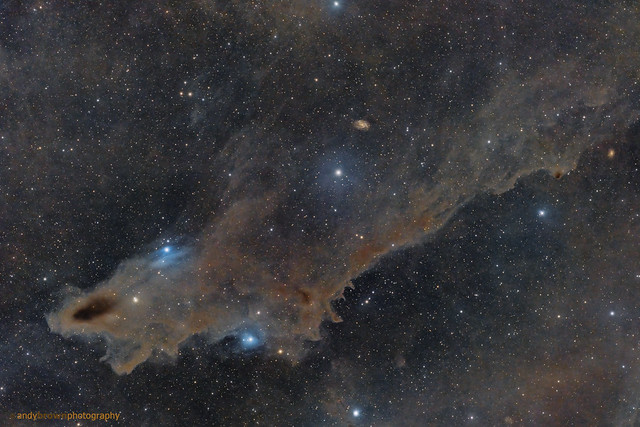
The Dark Shark (In Explore 4 Feb 2024)
An interesting part of the northern sky, in the constellation Cepheus, with clouds of dark dust, LDN 1235, making the easily recognisable Shark, two reflection nebulae (vdB 149 and vdB 150) and a couple of distant galaxies, one of them (PGC 67671) near the centre of the field is some 55 million light years distant. This has been captured over several nights in January 2024 as a side project to complete the night after my other targets in Orion have got too low.
Capture details and hires on Astrobin: astrob.in/qh8hus/0/

The Boogeyman Nebula (LDN1622) (In Explore 14 Jan 2024)
This area in the well known constellation of Orion consists of dark dust and Hydrogen emissions, including a small part of Barnard’s Loop which surrounds the familiar stars of Orion.
For more details have a look on Astrobin: astrob.in/p1id2c/E/

The Iris and the Ghost (in Explore 24 Dec 2023)
The Iris Nebula (NGC 7023) and the Ghost Nebula (SH2-136) in the constellation Cepheus are reflection nebulae shrouded in dark, molecular dust.
Capture details and info on Astrobin: astrob.in/xfcobc/0/

SH2-119 (in Explore 3 Sept 2023)
My first image for some time due to problems with my mount in February, which has since been repaired (new control boards) and also the lack of darkness over the summer here in the UK.
SH2-119, sometimes called the Clamshell Nebula, is a close neighbour of the North America Nebula and Cygnus wall but not often imaged. Processed as SHO with channel and colour balance achieved using Bill Blanshan’s new NarrowBandNormalisation script in PI which makes the job of matching channels so much easier.
Capture details on Astrobin: astrob.in/zi4xky/E/


